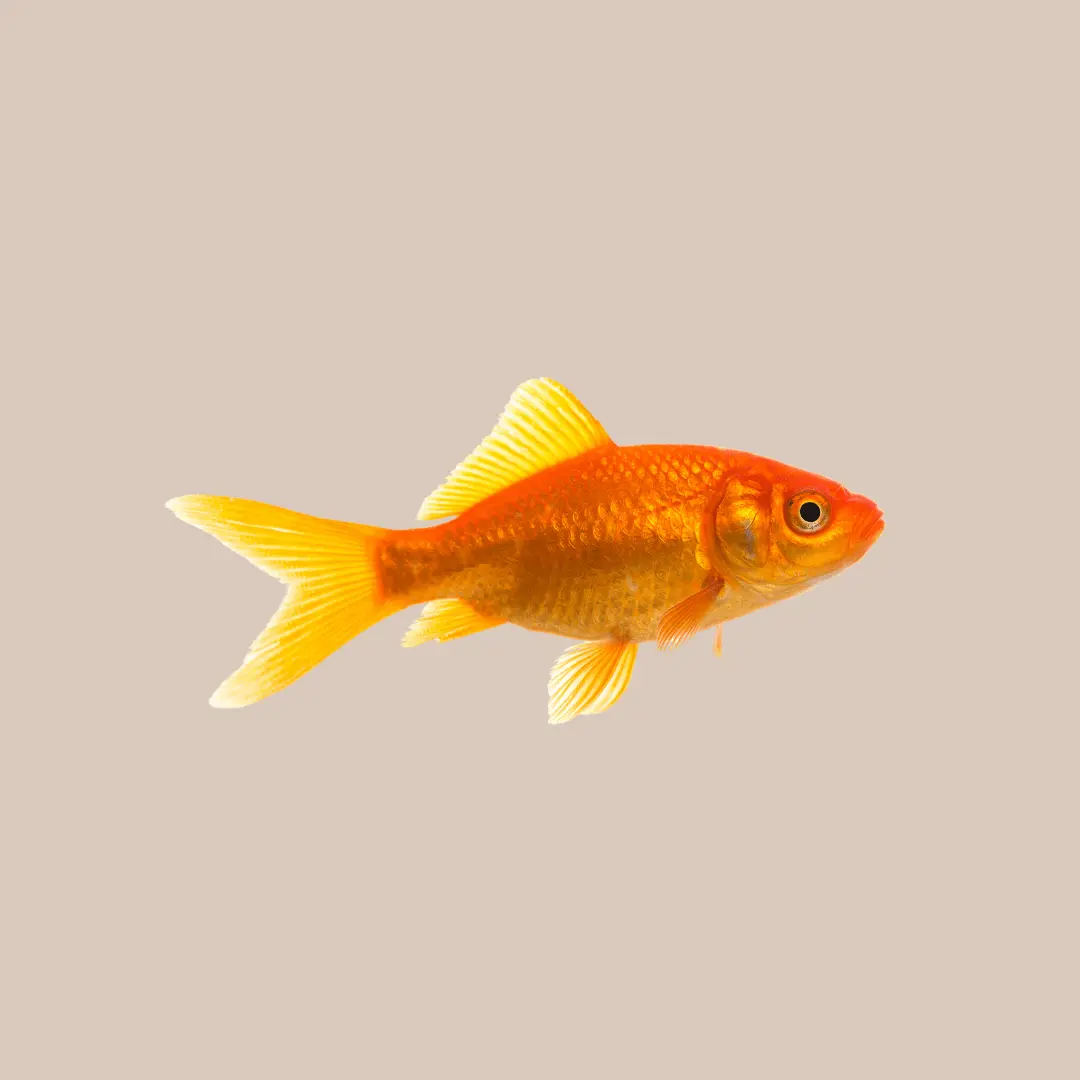
Orange Comet Goldfish
Goldfish Common Name: GoldFish
Goldfish Size: up to 25cm
Goldfish Diet: Omnivore
Goldfish Water Type: Fresh
Goldfish Optimum pH Level: 6.5 - 7.2
Goldfish Life Span: 30 years
The goldfish is a freshwater fish in the family Cyprinidae of order Cypriniformes. It was one of the earliest fish to be domesticated, and is one of the most commonly kept aquarium fish.
Goldfish as Pets:
Goldfish have strong associative learning abilities, as well as social learning skills. In addition, their visual acuity allows them to distinguish between individual humans. Owners may notice that fish react favorably to them (swimming to the front of the glass, swimming rapidly around the tank, and going to the surface mouthing for food) while hiding when other people approach the tank. Over time, goldfish learn to associate their owners and other humans with food, often "begging" for food whenever their owners approach.
Goldfish are gregarious, displaying schooling behavior, as well as displaying the same types of feeding behaviors. Goldfish may display similar behaviors when responding to their reflections in a mirror.
Goldfish have a memory-span of at least three months and can distinguish between different shapes, colors and sounds. By using positive reinforcement, goldfish can be trained to recognize and to react to light signals of different colors or to perform tricks. Fish respond to certain colors most evidently in relation to feeding. Fish learn to anticipate feedings provided they occur at around the same time every day.
Goldfish Habitat:
The goldfish is classified as a coldwater fish, and can live in unheated aquaria at a temperature comfortable for humans. However, rapid changes in temperature (for example in an office building in winter when the heat is turned off at night) can kill them, especially if the tank is small. Care must also be taken when adding water, as the new water may be of a different temperature. Temperatures under about 10 °C are dangerous to fancy varieties, though commons and comets can survive slightly lower temperatures. Extremely high temperatures (over 30 °C can also harm goldfish. However, higher temperatures may help fight protozoan infestations by accelerating the parasite's life-cycle—thus eliminating it more quickly. The optimum temperature for goldfish is between 20 °C and 22 °C.
Like all fish, goldfish do not like to be petted. In fact, touching a goldfish can endanger its health, because it can cause the protective slime coat to be damaged or removed, exposing the fish’s skin to infection from bacteria or water-born parasites. However, goldfish respond to people by surfacing at feeding time, and can be trained or acclimated to taking pellets or flakes from human fingers.
Original: $4.50
-65%$4.50
$1.57Product Information
Product Information
Shipping & Returns
Shipping & Returns
Description
Goldfish Common Name: GoldFish
Goldfish Size: up to 25cm
Goldfish Diet: Omnivore
Goldfish Water Type: Fresh
Goldfish Optimum pH Level: 6.5 - 7.2
Goldfish Life Span: 30 years
The goldfish is a freshwater fish in the family Cyprinidae of order Cypriniformes. It was one of the earliest fish to be domesticated, and is one of the most commonly kept aquarium fish.
Goldfish as Pets:
Goldfish have strong associative learning abilities, as well as social learning skills. In addition, their visual acuity allows them to distinguish between individual humans. Owners may notice that fish react favorably to them (swimming to the front of the glass, swimming rapidly around the tank, and going to the surface mouthing for food) while hiding when other people approach the tank. Over time, goldfish learn to associate their owners and other humans with food, often "begging" for food whenever their owners approach.
Goldfish are gregarious, displaying schooling behavior, as well as displaying the same types of feeding behaviors. Goldfish may display similar behaviors when responding to their reflections in a mirror.
Goldfish have a memory-span of at least three months and can distinguish between different shapes, colors and sounds. By using positive reinforcement, goldfish can be trained to recognize and to react to light signals of different colors or to perform tricks. Fish respond to certain colors most evidently in relation to feeding. Fish learn to anticipate feedings provided they occur at around the same time every day.
Goldfish Habitat:
The goldfish is classified as a coldwater fish, and can live in unheated aquaria at a temperature comfortable for humans. However, rapid changes in temperature (for example in an office building in winter when the heat is turned off at night) can kill them, especially if the tank is small. Care must also be taken when adding water, as the new water may be of a different temperature. Temperatures under about 10 °C are dangerous to fancy varieties, though commons and comets can survive slightly lower temperatures. Extremely high temperatures (over 30 °C can also harm goldfish. However, higher temperatures may help fight protozoan infestations by accelerating the parasite's life-cycle—thus eliminating it more quickly. The optimum temperature for goldfish is between 20 °C and 22 °C.
Like all fish, goldfish do not like to be petted. In fact, touching a goldfish can endanger its health, because it can cause the protective slime coat to be damaged or removed, exposing the fish’s skin to infection from bacteria or water-born parasites. However, goldfish respond to people by surfacing at feeding time, and can be trained or acclimated to taking pellets or flakes from human fingers.